Time has made a change in me
Wonderings
Who would you not want to spend eternity with?
Is there a version of yourself that you can never go back to?
Reflection on these Wonderings + Texts for theTwenty-second Sunday after Pentecost
Job 19:23-27a; Psalm 17:1-9; Luke 20:27-38
Let us speak, and listen, held in the presence of our loving, liberating, and life-giving God. Amen.
The readings assigned to us in this season invite questions about what happens after life. About the legacies we have inherited and the legacies we will one day leave behind. About where our awareness and maybe our bodies will go after we die, about the kind of change, the kind of transformation we might be talking about when we talk about resurrection. About the music we can hear, even now, faintly, up above our heads.
Last week, I had invited us to wonder together about times when those who had died felt mysteriously present, and close. I invited us to wonder about the legacies we had inherited and wanted to carry on. And after church, several people told me that it had been hard for them, at least initially, to think about positive examples of ancestors. It was much easier to call to mind ancestors whose legacies they didn’t want to carry on, ancestral traumas that haunt them, and they’d like to heal, or leave behind.
And let me just say—I think that is excellent wondering. There’s no wrong way to do it, if we honestly follow what’s coming up for us. And I think it’s worth spending some time with these ancestors that we don’t like. I think it’s worth spending time with the reality that some of those who have gone before us have left us an inheritance that is not a blessing but a wound. It’s the question behind that first wondering question today…who do you not want to meet again in another life? Who would you meet in heaven, that would make even heaven into hell?
I wonder if that might be a way to think with this woman “given” seven times in marriage to seven different brothers. The Sadducees pose this question to Jesus: who will she be married to in this “resurrection” you speak of, Jesus? Luke helpfully notes that the Sadducees do not believe in the resurrection. So we know that this is a bad faith question, a “gotcha” question.
And I would add, as a sidebar, that while scholars don’t know a ton about the Sadducees, they seem to have been a very powerful minority movement within Israelite political and religious life. This is a bit geeky, in the weeds—feel free to tune this part out.
The Sadducees were religious and political conservatives, who based that conservatism on a narrow reading of the Torah, the five books of Moses. They did not give authority to any later writing or tradition. (Kind of like “textualists” and “originalists” on the Supreme Court claim not to care about anything other than the plain meaning of the U.S. Constitution., and seem to be suspicious of rights and freedoms that were fought for and won after 1789.)
Specifically, the Sadducees do not give any credence to the idea that had emerged roughly 200 years before the time of Jesus, that the dead shall be raised in some climactic moment at the end of time, and justice denied in this life would finally be done in some eternal afterlife. I mentioned this last week with our reading from Daniel, who was living through a time of terrible persecution under the cruel and colonizing regime of the Greek King Antiochus IV. In the midst of that, Daniel had this prophetic vision that children of Israel who were killed for their faith would inherit the true kingdom, for ever and ever.
Jesus, like his frequent sparring partners the Pharisees, are integrating this prophetic vision of a life after death into their own prophetic imaginations. They are deconstructing and reconstructing their understanding of justice, and including this possibility that some day, somehow, present powers will be brought low and those who have been cast down will be raised up.
But again, the Sadducees reject all the emergent visions of resurrection, and they reject the possibility that divine justice would overturn the existing social order—which, no surprise, is serving them quite well. So again, they’re mocking Jesus with this question, of who this imaginary woman would be married to. Or perhaps more accurately—which of the seven brothers will she be given back to? Whose property will she be?
End sidebar.
Maybe the question is not which guy she will be married to in heaven, but would she even want to be in heaven with ANY of them? With any of her owners, who expected her to produce for them—produce an heir? Would she have to spend eternity with one of them?
Will we have to spend eternity with the people who have hurt us, who have used us, who have let us down? This framing gets me worried that heaven will turn out to be a never-ending dinner party with my most emotionally immature extended family on this side, and on this side, all my ex-girlfriends?
It’s a gotcha question, but Jesus engages with it. He responds generously, at length. And he calmly challenges the basic premise that the Sadducees bring: that the future will be like the past. The only way they can imagine the resurrection is a return to what has already been: the eternal reestablishment or reinstatement of a prior state… In the resurrection, we’ll all be the same, and everyone else will be the same. No growing, no healing, no reconciliation or integration…
But Jesus says that in his imagination, the resurrection no one will be married, or given in marriage. We will be closer in nature to the angels, to children held close to the bosom of God. And having our selves so expanded will surely bust open the relationship at the heart of heteropatriarchal marriage in Jesus’ day, and still in our own. No one will be property, and no one will be a possessor.
So Jesus imagines that the resurrection will entail some kind of transformation, some kind of expansion of our being such that this new being cannot be contained by past categories. In the resurrection we will transcend all the past versions of ourselves, and yet still be us. Which makes me wonder if this expanded being will not leave our past selves behind, but include them, gather them in, heal them.
Which makes me wonder, if we do meet those we now fear to meet in heaven, if we’ll see their wounds healed, and the scars shining with the light of distant stars just being born. Maybe we’ll feel our own hearts expand, our old resentments eased and salted with compassion. Maybe we might discover that there was more to those that hurt us, or that we hated. And we’ll go, “oh—this is what forgiveness feels like.”
As I said last week, I don’t feel very confident about what happens after we die; all that stuff about Daniel kind of inventing the idea of heaven as a place of eternal reward is kind of geeky and in the weeds, but the reason that stuff matters to me is that we see Jesus and others around him drawing on this idea that had been around for a very short time and was still being worked out—and they’re using that idea to make meaning out of their own experience. To me, that gives us permission to hold their ideas about an afterlife loosely, and it gives us permission to draw on their ideas to make meaning of what we’re going through now.
Here’s a closing thought. Let’s imagine, for the sake of argument, that this idea of the resurrection as a place of healing and liberation, of reconciliation and ease, transcendence and inclusion…let’s imagine that’s what’s waiting for us. Why would we have to wait until we die to know what forgiveness feels like? What if that is the kind of transformation that we could tap into now? What if the way we were being changed, over time, in this life, felt like a process of loosening old resentments, of liberation from containers that were too small for our ever-expanding being? What if we were being changed, now, into children of God?
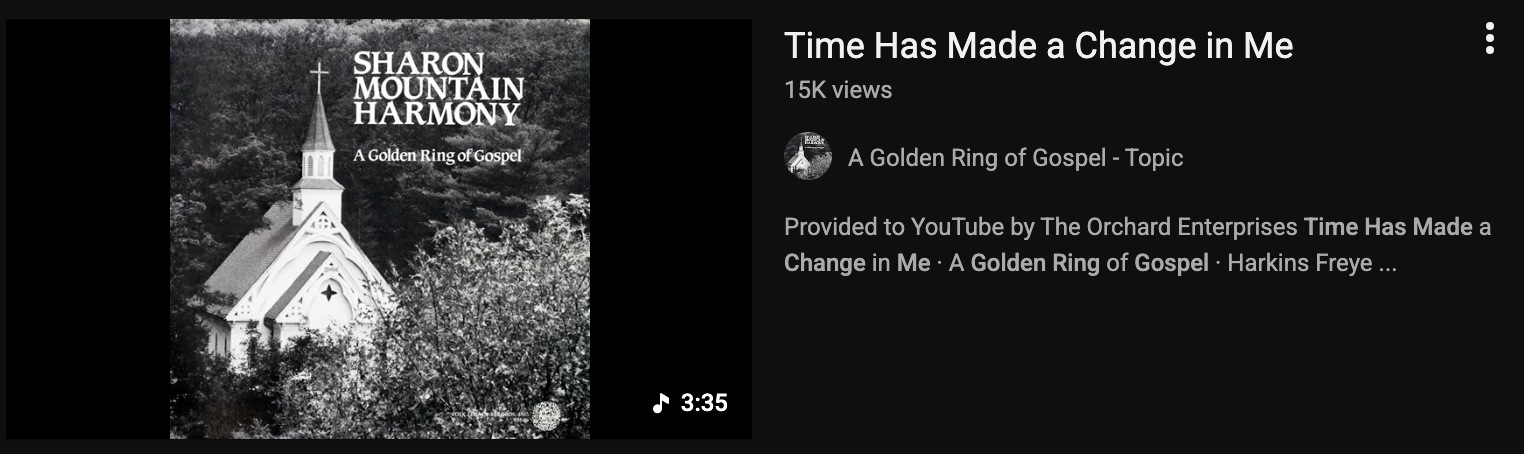
Earlier this week I came across this folk song that really moved me, because it points to the way that time changes us, whether we like it or not. It doesn’t move me because it says that everything will be ok in the end; it moves me because it has the bittersweetness of the truth. We can never go back. We can never go back and choose different wounds than the ones we have. We can only start from here.
Time has made a change since my childhood days
Many of my friends have gone away
I am not the same as I used to be
Time has made a change in me.
Time has made a change in the old home place
Time has made a change in each smiling face
And I know my friends can plainly see
Time has made a change in me.
Amen.