Honoring our Transgender Ancestors - and our trans siblings who have died this year.
Wonderings
I wonder when you’ve really gone for it; “left it all on the field” or “on the stage,” when you’ve given all you had to something you cared about.
I wonder what hard decisions you might be weighing right now…
A collaborative reflection on these Wonderings + Texts for theTwenty-Third Sunday after Pentecost
Malachi 4:1-2a; Psalm 98; Luke 21:5-19
… + our own experience + those whose legacies inspire us.
Let us speak, and listen, held in the presence of our loving, liberating, and life-giving God. Amen.
There’s so much that is beyond our control. This has always been the case, but perhaps we are more keenly aware of it, made more anxious by it, in this year of our Lord 2025. There is so much happening, and we don’t have time or perspective to understand or interpret all the signs. There are so many overlapping crises that we face—some collective, some so personal that no one knows about them except you and God. It can feel like the structures that generations have so patiently built up are being thrown down, and maybe the day is soon coming not even one stone will be left upon another.
This gospel lesson appointed in our lectionary cycle of readings reminds us that of course we are not the first to fear persecution, not the first to face betrayal by those we rely on. Those who have gone before us felt overwhelmed; they wondered, as we sometimes do, if they were living at the end of the world. They felt themselves flooded, as we do; they felt their bodies gear up to fight or flee, or felt them shut down or freeze.
Just reading this appointed gospel lesson out loud gets my body spooled up. And so my attention goes to the words that feed that spooled up feeling, that resonate with my anxiety, with my many threat-detection devices.
Wars and insurrections, famines and plagues…and then I start thinking about the people we meet at our Thursday food distribution, and the many people who are hungry in this city today, and I start worrying about what war Trump will start to distract us from the rest of his corrupt and illegal actions, if the Centers for Disease Control under RFK Jr. will be prepared for the next pandemic…and inside, under this cool, calm exterior, I start freaking out.
Maybe you too. So let’s practice together, honoring that we have good reasons to be anxious. Let’s breathe together, and honor that it is hard for us, for such much to be beyond our control. Let’s breathe together, and honor that it is stressful for so much momentous stuff to be occurring, and not be able to keep up, not to be able to “read the signs.”
Let’s practice listening to the wisdom that Jesus offers us, in the midst of this activation…
I notice here that Jesus does not attempt to minimize his followers’ fears and anxieties. He acknowledges them; he acknowledges that messed up stuff is happening and will happen. He acknowledges that his followers will suffer directly, personally: they will not be insulated from the trauma of the times, from all that is beyond their individual control.
But I notice also that Jesus then gently focuses his followers’ attention on what is within their control. Before all the earthquakes and world historical scary stuff, he says, you will have choices to make, and the power to make them; you will have occasions to give yourself to what is worthy of your life, to testify to what is worthy of love.
And Jesus says something that doesn’t make any sense to the anxiety-brain, that doesn’t compute with stress hormones flooding the system. He says that we don’t even need to plan for these moments; we don’t need to strategize, or run contingency scenarios. Because we will not be alone. Jesus himself promises to be there, and we will be given the words. The words will just come through us. “I”—the liberator, the redeemer, the beloved—“I will give you words and a wisdom that none of your opponents will be able to withstand or contradict,” he says.
In the moment of decision, in the moment when we must choose how we will pour ourselves out, and for what, we will be able to trust ourselves, and trust that a loving, liberating, and life-giving God will show us the way.
Our tradition also teaches us that when we are called to testify to the truth, to testify to love, we will be surrounded by a great cloud of witnesses. And perhaps here, in this place, we can sense that they are already here, surrounding us, joining in our song, rooting for the parts of us that are just beginning to sprout, just beginning to heal.
And today, as we mark the Transgender Day of Remembrance, I want to think specifically about the trans folks in that cloud of witnesses: who show us what courage looks like, what defiant dignity and grace and ease look like, even as they were handed over to kings and governors because of the shape of their lives and their loves. Some of these trans ancestors were betrayed even by parents and siblings, by relatives and friends. Some of them were even put to death because they testified to a life that can never be contained by binaries or hierarchies. Who testify, still today, that the love we know as God calls us to become richer and stranger than we had imagined was possible.
To help us center ourselves in gratitude for those trans ancestors, I wanted to invite our own Ali Dineen (she/they) to speak about their song Either Or, their work with the legacy of Joan of Arc, and how some of these dots connect for them.
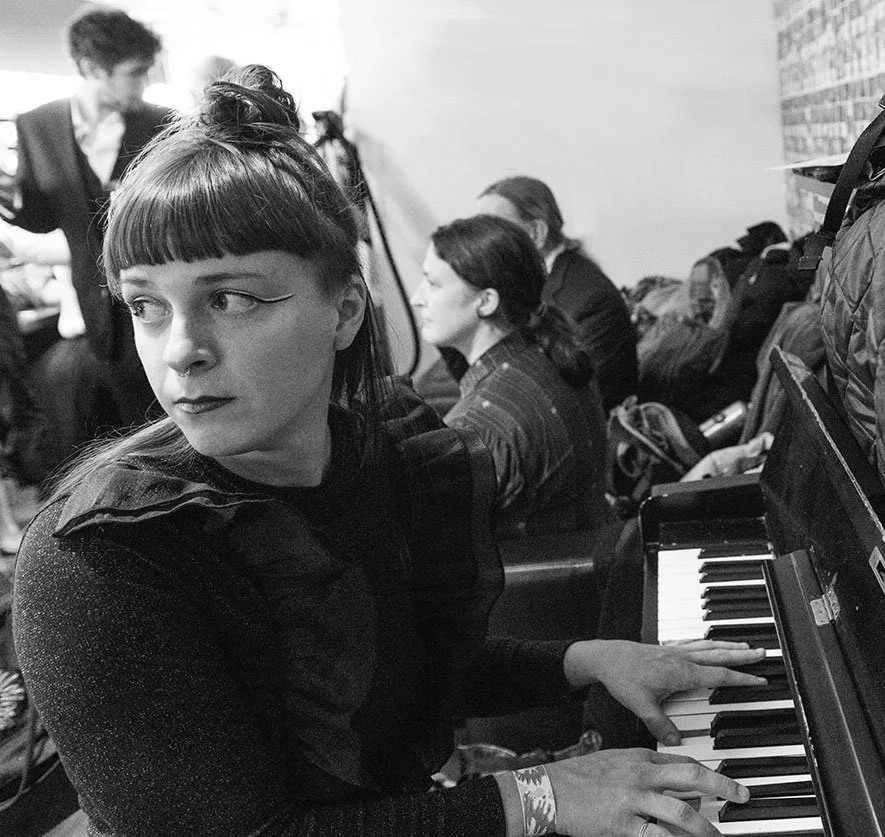
Ali Dineen, at Joe’s Pub
Ali Dineen:
Thank you Carl.
In a few minutes, I’m going to play my song, “Either, Or.” But first, I would like to begin by reflecting on Joan of Arc.
Many of you probably know the broad strokes of Joan of Arc’s life: a peasant in northern France, at the age of 12 she began receiving visions and visitations from saints and the Archangel Michael, which eventually told her she must lead France to victory against the Burgundians who threatened the nation. She went to the King of France and eventually, somehow, convinced him to let her lead his armies in its ongoing wars with the English and their allies. She led some successful military campaigns, but was eventually captured by enemy forces, brought to trial, and burned at the stake for heresy.
I grew up going to Saint Joan of Arc Catholic Church in Jackson Heights. I remember images of her all around the church, and my mom taking pride in that our church was named after her. But I never knew much about her story besides that she was burned at the stake, and for many years I thought she had been accused of witchcraft, like many hundreds of thousands of women who were murdered around that time in medieval Europe.
When I was 30, I read Transgender Warriors by Leslie Feinberg, which opens by talking about none other than Joan of Arc. Feinberg wrote that Joan was one of the first historical examples they'd ever encountered of cross-dressing or gender nonconformity. And it was then that I learned that Joan was officially executed -- by the same Catholic church that would later make her a saint -- for refusing to wear women's clothing. That was the official reason.
For me, this revelation began a (still ongoing) fixation on Joan, her story, and what it represents. I see my learning about the facts of her story so many years after growing up in that church, as a kind of microcosm or metaphor for the way that nuance and truth can get lost depending on who is writing history.
Trans people have existed for millenia, but they have often been written out, or violently erased, metaphorically and literally. My own learning about trans people throughout history, and beloved relationships with trans people today, have all been guideposts for me as I move through my life. They have shown me what true bravery looks like, and how to move with grace and dignity in the face of hatred, cruelty, and intolerance. They have been an inspiration for me as I explore my own relationship to gender. I am not trans, but I am also not exactly cisgendered; and though my gender fluidity isn’t a big part of my public-facing self, it feels essential to who I am and how I understand the world around me. And maybe most importantly of all, I have learned about hope and possibility from these histories and friendships.
I wrote my song “Either, Or” after reading another book by Leslie Feinberg called Stone Butch Blues. Towards the end of this novel, the protagonist Jess, who is nonbinary, falls in love with Ruth, a trans woman who lives in the same building on the Lower East Side of NY. In one scene in particular, Jess comes home to find a surprise: Ruth has painted the ceiling of Jess’ bedroom like the night sky, blue with constellations all across it.
But Jess is a little unnerved, and says: “I can’t tell if it's dawn or dusk you’ve painted.”
Ruth replies: “It’s neither. It’s both…It’s a place inside of me I have to accept. I thought it might be what you need to deal with, too…It’s not going to be night or day, Jess. It’s always going to be that moment of infinite possibility that connects them.”
I would like to dedicate this song to all the in-betweens within us and outside of us, and to the infinite possibilities that exist outside of the narrow binaries we sometimes cling to. And to Leslie Feinberg, and Joan, two of my most beloved ancestors.
Ali plays “Either Or”
Amen.