Singing the songs of our ancestors, trusting they sing with us

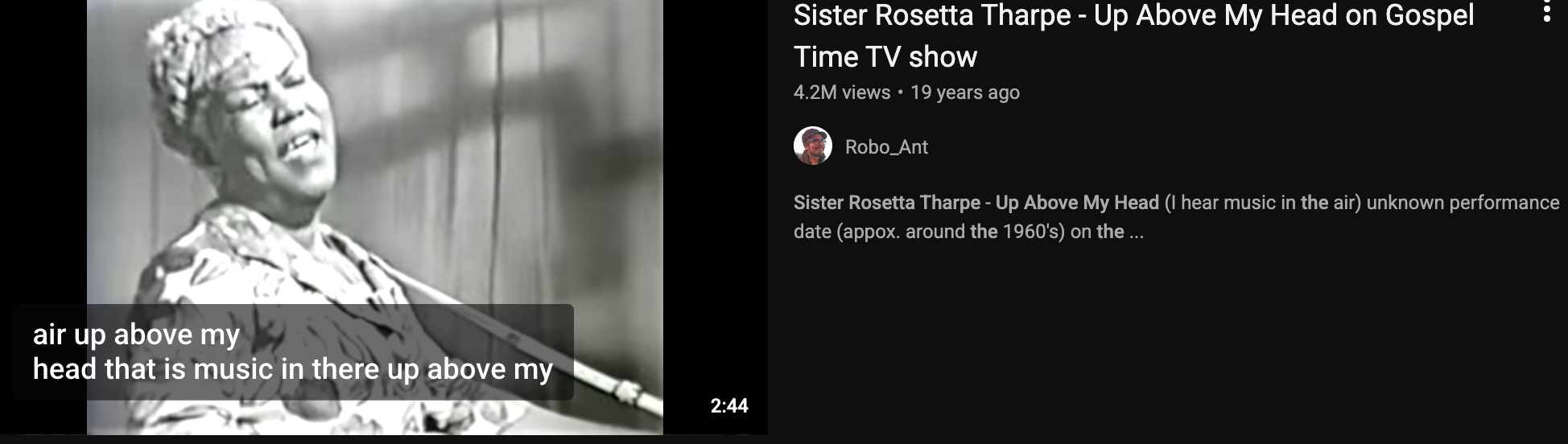
Sister Rosetta Tharpe (1915-1973): the first rockstar.
Wonderings…
I wonder if you’ve ever felt that someone who had died was with you.
I wonder if you have an ancestor whose legacy you want to carry on—and what that legacy is..
Reflection on these Wonderings + Texts for the Feast of All Saints, Year C.
Daniel 7:1-3,15-18; Psalm 149; Luke 6:20-31
Up above my head, I hear music in the air, and I really do believe there is joy somewhere.
Let me tell you a little bit about Sister Rosetta Tharpe, whose song we’re just sung, and will be singing for the next few weeks. She was born in 1915 to poor Black tenant farmers in Cotton Plant, Arkansas. She and her mother moved to the South Side of Chicago in the 1920s, where they joined the 40th Street Church of God in Christ—a charismatic community where little Rosetta’s precocious musical talents were nurtured, and where everyone called her “Sister Rosetta.”
Sister Rosetta learned music from her mother, and from the touring musical evangelists who rolled through Chicago. And in those days, in Chicago’s Black neighborhoods you couldn’t help but breathe in the blues, so she learned them too.
Before she turned 20 years old Sister Rosetta Tharpe had toured all over the country with other Gospel acts, performing in churches and revival tents. In 1938, when she was just 23, she played at the Cotton Club here in New York City. And that was her big break, leading to bookings at the Paramount with Count Basie, the Apollo with Fats Waller, and even at Carnegie Hall.
The thing that made Sister Rosetta Tharpe notable then wasn’t just that she was one of the first to bring the depth and fervor of gospel music to secular stages, and white audiences.
It was that Sister Rosetta Tharpe sang gospel songs while she wailed on electric guitar. Again, this is the 1930s and 40s. For those who know her name, Sister Rosetta Tharpe is acknowledged as perhaps the first rock star; at the very least, the godmother of what we now call rock and roll.
Chuck Berry later said that his whole career was one long impression of Sister Rosetta Tharpe. The windmill move made famous by Pete Townsend of the Who? Who did he learn it from? Elvis was a devoted fan; so was Johnny Cash; so was Bob Dylan.
Up above my head, I hear music in the air, and in these days when it can be so hard to believe in joy—I really do believe there is joy somewhere. Because I believe Sister Rosetta Tharpe when she sings it. I believe in her belief; and that carries me. Some days, I need that encouragement to take the next faithful step.
Today we mark the feast of All Saints—when we remember those who have gone before us, whose memories sustain and inspire us. Today we remember those who help us trust that the path will lead us on to justice and joy, and who, in some mysterious way, are walking along beside us: goading us, guiding us, whispering encouragement in our ears.
Today we honor our ancestors in the faith who have gone before us. We honor them by singing their songs: the songs they learned from their ancestors, and made their own, and we make them our own, and so our ancestors live on in us. Their struggle and their wisdom shaping us. Their wounds, perhaps, healed in us, and through us.
The lyrics and the tune of “Up above my head” can be traced back to the 19th century, and the experience of Black people debased by white enslavers, dehumanized by an entire economic system that extracted their labor with violence to produce wealth for somebody else. And they knew it was wrong. Everything in them screamed that this was wrong—that this was a living hell. And though many escaped, and some, like Harriet Tubman, even came back to free others, many never lived to see freedom. And we can imagine how important it may have been to them, that the justice they were denied in their lives would be their eternal reward in heaven—and that the ones they loved who had already died were there, up above their heads.
That’s part of what’s happening in this cryptic reading assigned today from the Book of Daniel. Daniel reports this prophetic dream, of four great winds and four great beasts—and what he’s likely talking about are four different empires who would debase and dehumanize the people of Israel. And Daniel himself is living through such imperial violence, about 160 years before the birth of Jesus. The Greek King Antiochus IV has conquered Jerusalem and has criminalized Israelite religious practice. Observant Jews are literally being given the choice to eat pork or die.
And in the midst of this, Daniel develops the historically novel idea of a heaven where just living will be rewarded, in ways it is punished in this world. Up until this point, the Israelite idea of the afterlife was distinct from, but largely similar to the Roman concept of Hades; She’ol was not a place of punishment, but simply the underworld place where everybody goes after they die. A place of shades, a monochromatic world, without substance, without feeling, without passion, without life.
But Daniel is promising those around him who are unwilling to give up their faith, that they will be rewarded in another world, up above their heads. And “the holy ones of the Most High shall receive [that] kingdom and possess [that] kingdom for ever—for ever and ever.”
And we hear that theme picked up 250 years later, in Luke’s Gospel, as Jesus teaches: when people hate you, exclude you, revile you, or defame you… “rejoice”—even “leap for joy”— “for surely your reward is great in heaven.”
These teachings we hear today are traditionally called the Beatitudes. Beatitude means blessedness. And they show the tension that exists throughout the Bible, about whether blessedness is something we might experience here on this earth; or if true blessedness is to be found on another plane, which we reach either in sanctity or in death. In the Bible, blessedness is something already here, already available; and not yet known, not yet arrived; elsewhere.
There’s another tension in Christian ideas about beatitude, evidenced even here in our readings. Is beatitude something we can experience through our own integrity, our own fidelity? Or…will beatitude be complete when we have emerged victorious over our enemies, when the sinners are punished? As we heard, and read, in our psalm today…
“Let the faithful rejoice in triumph; *
let them be joyful on their beds.
Let the praises of God be in their throat * [record scratch'!]
and a two-edged sword in their hand,
To wreak vengeance on the nations *
and punishment on the peoples.”
This tension between integrity and victory is there even in Luke’s version of the Beatitudes. Love your enemies, do good to those who hate you, bless those who curse you, pray for those who abuse you; turn the other cheek… AND…woe to those who are laughing now—you’re gonna get the hammer!
If this discussion of the readings has gotten too in the weeds here, let me sum up by saying that if heaven and hell are important parts of your spiritual imagination—you belong here. And if you have questions about what happens what we die, or feel unconvinced by the stories that have been handed down to us—you belong here too.
I confess that I do not feel very confident that I know what happens when we die. I trust in this Christian tradition that puts resurrection at the center of our story; and so I trust that death is not the end. And I experienced in my own life the indomitability of love, and the continued presence of those I love, and have lost. And so I say again, death is not the end—the end of life, or the end of love.
But for me the afterlife isn’t something we can have knowledge about; it’s something we tell stories about, or sing about. So I want to conclude by returning to music, and the story behind another song we will sing a bit later, and will learn now.
Repeat after me: Siyahamba ekukhanyen kwenkhos
This is the Zulu language, which is spoken around South Africa. It means “We are marching in the light of God.”
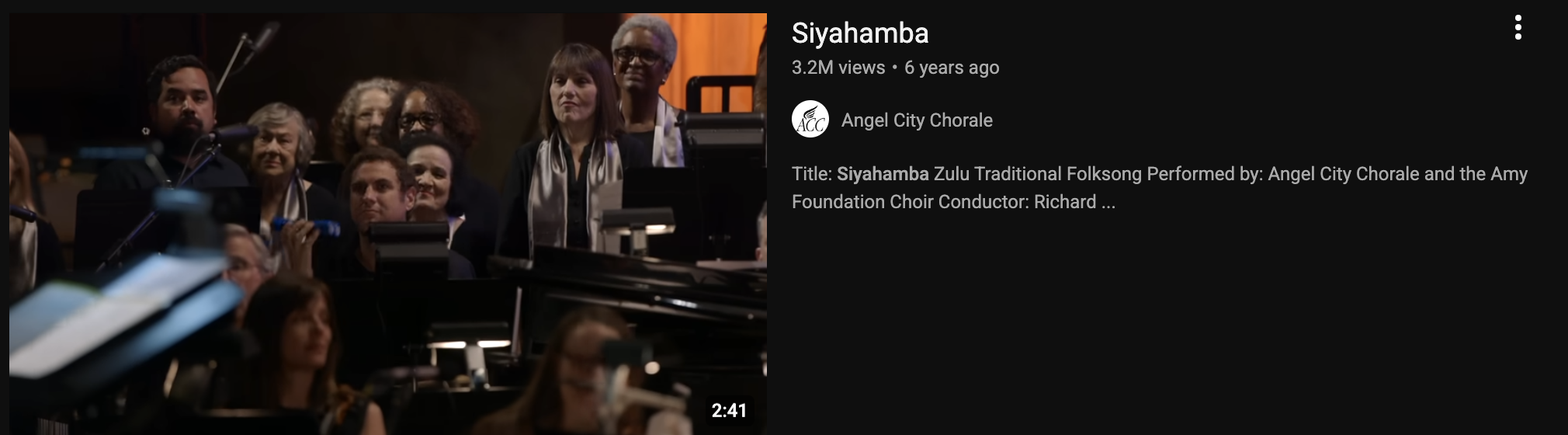
Nobody is quite sure about the exact details, but this song seems to have come from a grammar school in the province of Natal, maybe as early as the 1950s. It seems to have been widely regarded as a children’s song. And when this song was brought to Europe and the United States, it kept that connotation; I myself learned it in the summer between fourth and fifth grade at church camp. But much later I heard another story about this song—about what this song became.
The story I heard was that, during the long, long, bloody struggle to end apartheid, Black freedom fighters would go to the morgue to claim the bodies of their comrades who had been killed by the South African Army, or by white vigilante mobs. They would bring a wooden casket, rough-hewn; they would gently place their beloved’s body in the casket, and carry it out into the street. And they had a ritual for this funeral procession. It was not somber, but defiantly joyful; the eyes of the pallbearers were not cast down, but lifted up to the music their oppressors could not hear; the music up above their heads.
And they sang… siyahamba ekukenyen kwenkhos. We are marching in the light of God.
Blessed are those who mourn—because we know that those we love are still with us; we know that in fighting for freedom in our own day we are fighting for God’s own dream; we know that in the long march toward justice, that we are marching in the light of God. And we know that we do not march alone: for those who have died march with us; and they sing with us too.
Amen.