Embracing a secondary role
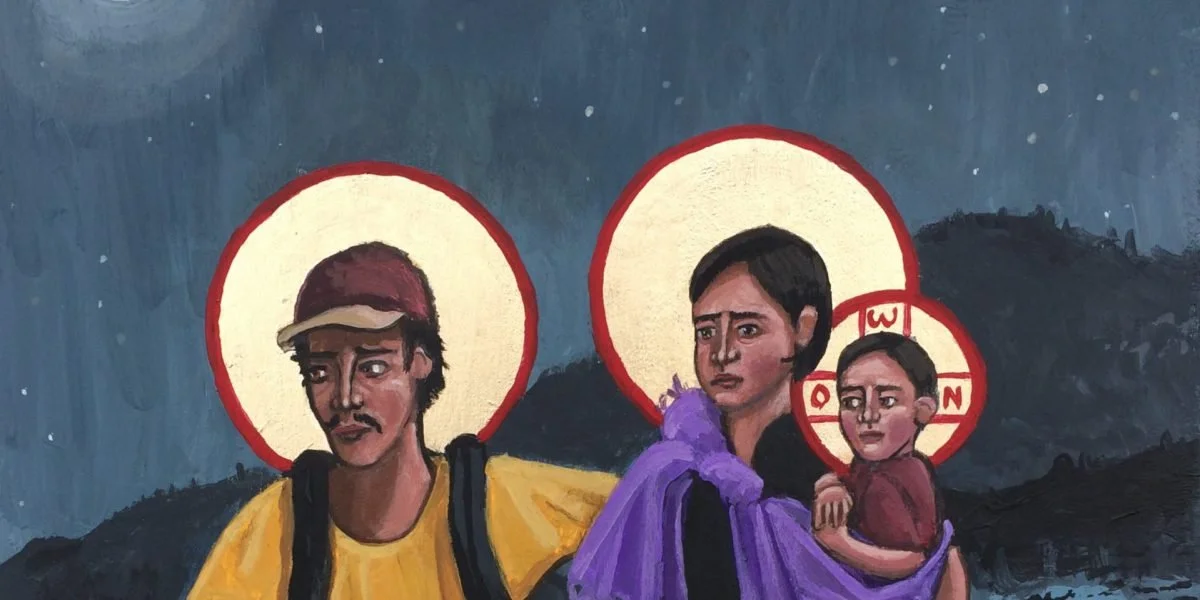
La Sagrada Familia, by Kelly Lattimore
Wonderings:
I wonder if anyone has taken your words out of context recently.
I wonder if you’ve been in a situation where the right thing to do was to do…nothing.
Reflection based on these wonderings + the readings assigned for the Fourth Sunday of Advent in Year A in our lectionary.
Isaiah 7:10-16; Psalm 80:1-7, 16-18; Matthew 1:18-25
Let us speak, and listen, held in the presence of our loving, liberating, and life-giving God. Amen.
At this season of my own spiritual life, I find that I’m quite skeptical of “one size fits all” answers and universalizable commandments. Honor your father and mother—yes; unless they are harming you. I think that stealing is wrong—but starving is worse. There aren’t a lot of rules or commandments that I hear—in the Bible or in secular culture or in our political life—where I think, yes, that is the right thing to do, 100% of the time, regardless of context.
Love the Lord your God with all your heart and mind and strength; love your neighbor as yourself. Jesus offers these as the two greatest commandments, and I would definitely say that these are the right things to do at any time and in any situation. But what that looks like in practice is going to be a matter of continual discernment. How to love your neighbor well is going to depend on who your neighbor is and where they’re coming from and what they need, and what you have to share, and…
When I think about mature spirituality, I think about continual discernment. Continual discernment whose fruit is courageous action in the integrity of love. Followed by more discernment, whose fruit is an updated form of courageous action in the integrity of deeper love… And on, and on, and on.
I’m starting here because I’m very aware that last Sunday, in reflection on the courage and humility of Mother Mary, I invited us all to wonder how the salvation of this wounded world might be born…in us? How might we—little old us—be called to bring a new world to birth…in this time and place?
Last Sunday I invited us to consider how we might be cast in a starring role in the unfolding of our greatest hopes, in the unfolding of God’s promise of healing and liberation for all.
And that’s a good and holy question. That might be the most important question for you to sit with in these days that call for courage, for resistance to the dehumanizing and destructive logic of empire.
But if we want to cultivate a mature spirituality, this is not the right question to ask, 100% of the time, regardless of context. We also need to ask, with Joseph in our Gospel reading today, how am I called to play a secondary role, a supporting role in the salvation of this wounded world? Or even—how am I called to stay out of the way, to do nothing? To let the seeds root in the soil, and not plow it all under, because of my anxious need to feel useful or in control?
For Joseph, the call is to not dismiss his fiancée Mary (even quietly) for finding herself pregnant, without Joseph’s help. To become the adoptive father to a child that is not “his own.” And this is quite a radical ask, if you think about it. In the ancient world, a father related to his children—especially male children—as an extension and expansion of his own selfhood. To put it a little crudely, for a father to have a son was an ego-boost, a status bump, an expansion of his portfolio—more than it was an invitation to care for this actual, needy, helpless child. Which, in that patriarchal culture, was largely women’s work.
So… Joseph has this dream in which he is told that Mary is at the center of this world-shattering event, of God becoming fully human—and he’s not really a part of it. He’s supposed to carry the diaper bag. But, “when Joseph awoke from sleep, he did as the angel commanded him.” He takes the hit to the ego. He smiles in the family photo shoot at the manger; he raises this child as his own, brings him to the Temple to be circumcised, teaches him his trade… He falls in love with this child, and cares for him, and cares for Mary, knowing always that he is part of the supporting cast.
I wonder if, in our culture which prizes action and agency, making your mark and blazing your own path—I wonder how you might be called to participate in healing and liberation by getting out of the way. Or working behind the scenes, out of the spotlight. Carrying the diaper bag.
I have been encouraged to continue with geeky digressions in these reflections. So here is a brief geeky digression on the virgin birth—the idea that Mother Mary was a virgin when she gave birth to Jesus:
I said last week that our tradition is a patchwork that has been taken apart and pieced back together again and again through history. We ourselves are doing what our ancestors did; we are trying to make sense of our experience of God—our wrestling with God, our disappointment in God, our joy in God, our longing for God. And we make sense of God by drawing on the stories and practices and beliefs that have been handed down to us—and by drawing on the best learning that is available to us in our time and place. We take ancient wisdom and contemporary learning and we piece them together. And then the next generation comes along and takes apart what we’ve made, and pieces it together a little differently, or a lot differently. Because they bring in knowledge and experience that their parents and grandparents didn’t have access to. And that leads them to highlight or reinterpret different parts of their inheritance of ancient wisdom.
So here’s how I understand the idea of the virgin birth. Early followers of Jesus were all trying to make sense of their experience of Jesus—either their experience of Jesus in his life and ministry, or their continued, mysterious experience of Jesus’ presence after his crucifixion, even generations after. They were trying to make sense of how their lives had been transformed by this person who lived out a love, deeper and more powerful than death.
So they looked back at the wisdom that had been handed down by their ancestors. And many early followers of Jesus got really into the prophet Isaiah, because many of the things he wrote 5 centuries before just leapt off the page at them, were so resonant with who they experienced Jesus to be—especially this verse in chapter 7, in which Isaiah writes of a child named Emmanuel: God with us.
I can just imagine these followers of Jesus just lighting up, reading this—we know what it’s like to feel the presence of God radiating out from a human being, to feel that God is with us in this profound, embodied way. Many of those first followers of Jesus came to think that Isaiah wrote this with Jesus in mind. (Which, if we read the passage in the original context, seems unlikely. As we can glimpse even from the short selection offered today, this passage from Isaiah was not a forecast of the birth of the Messiah, but a poetic way of saying that this conflict that King Ahaz is worried about will be resolved in the next 3-4 years—by the time a child born next month would be eating solid food and making some decisions for himself.)
The point I’m making here is that people have always read the Bible in light of their own experiences and longings. And then some of those interpretations are taken up by a community, they become a point of orientation. And as we receive that, our task is to ask if that orientation is life-giving.
The other important thing to understand here is that there’s a question of translation here. The prophet Isaiah was written in Hebrew. And if you read verse 14 of chapter 7, you come upon the Hebrew word עלמה (‘almah), which means “young maiden” or “young woman,” or “girl.” (Notice that that’s how it’s translated in our first reading—because the translators of the New Revised Standard Version were working from the Masoretic Text, the Hebrew text also regarded as canonical by our Jewish siblings.)
But most early followers of Jesus were Greek speaking Jews—and so they read Isaiah in a very popular Greek translation of the Hebrew Bible called the Septuagint. So when they read this verse, they came upon the Greek word παρθένος (parthenos) which can mean “young woman,” but whose primary meaning in the first century was “virgin.”
And so, informed by their belief that this passage was a foretelling of Jesus’ birth, some early followers of Jesus began to weave this idea of a virgin birth into the stories they told about him—into an origin story whose miraculous quality felt worthy of how miraculous his presence felt to them.
I’m not saying it can’t have happened. But I am saying that you don’t have to believe this to belong here.
And I’m saying that I think it is amazing, and also entirely patriarchal—and yet subversive of that patriarchal context—that the Gospel according to Matthew decided to tell this story from Joseph’s perspective. I find it moving and even convicting that this sotry is tole from the perspective of a man who feels demoted to a supporting role. From the perspective of one humbled… Who has nothing to give, nothing to offer but help.
In the bleak midwinter—God comes to us who have nothing to offer, who may even have mixed feelings about all this.
What shall I give him, poor as I am
If I were a shepherd, I would bring a lamb
If I were a wise man, I would do my part
But what shall I give him, give my heart.
Amen.