Wild hopes
Wonderings:
I wonder if you’ve ever shouted for joy.
I wonder: what’s the wildest thing you’ve ever hoped for?
Reflection based on these wonderings + the readings assigned for the Third Sunday of Advent in Year A in our lectionary.
Isaiah 35:1-10; the Magnificat (Luke 1:46-55); Matthew 11:2-11
Let us speak and listen, held in the presence of our loving, liberating, and life-giving God. Amen.
Today is the 3rd Sunday of Advent, which for centuries in the Western Christian tradition has been regarded as “Gaudete Sunday.” Gaudete means “rejoice.” It is a day we are invited to say with Mother Mary, the God-bearer, in humility and awe, with tears welling up—
My soul proclaims the greatness of the Lord,
my spirit rejoices in you, O God my Savior…
The traditional liturgical color for Gaudete Sunday is rose. And can we just take a moment to appreciate these Advent vestments that were made last year by Kaylyn Kilkuskie? Kaylyn is a textile and performance artist who lives just up the block here, and she and I met at the 45th St Green Space a few years ago, and got talking about adaptive reuse in her art practice. That led to a conversation about how the materiality of our sacramental life might show that things which have been cast down are being raised up—that the mighty are being cast down from their thrones, and the lowly lifted up.
That things which have grown old are being made new.
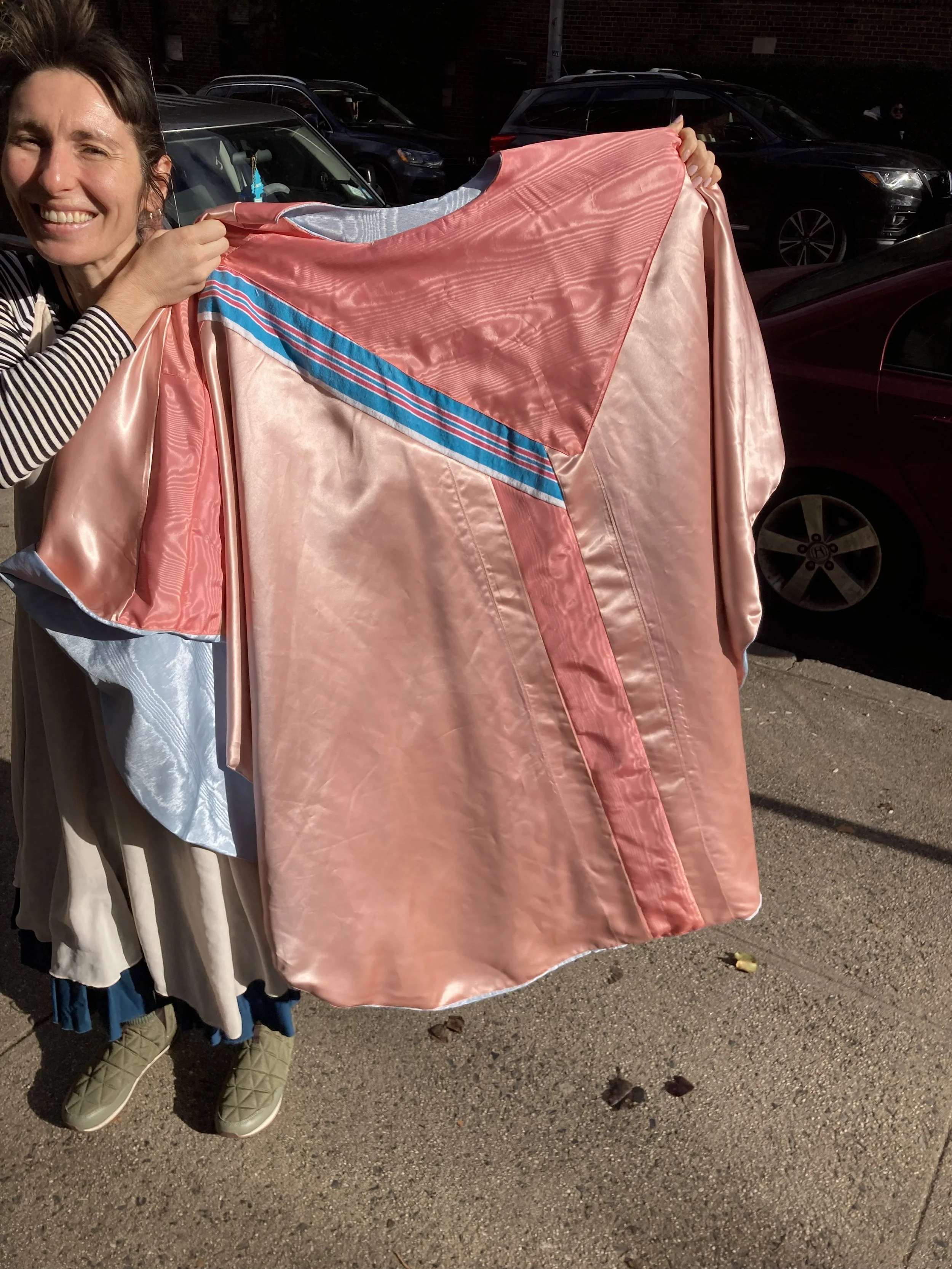
Kaylyn Kilkuskie showing the front of the Advent chasuble she made (the rose-colored side for “Gaudete” Sunday).
We ended up commissioning this altar cloth, and this stole, and this (reversible!) chasuble from Kaylyn. I wrote a bit about this in this week’s newsletter, and there’s a blog post about it linked there as well, but in making this reversible chasuble (and altar cloth), Kaylyn took apart a set of rose-colored vestments that belonged to All Saints Church here, and had seen better days. And she pieced that silk together with new, blue poly silk informed by the color of Mother Mary’s shawl in centuries of “Madonna and Child” paintings: the best thing we could get on our budget. And lastly, for the details, she used the flannel swaddle cloth that every baby born in a NYC hospital is wrapped in…because in Advent, we’re all, collectively, expecting a baby.
One of the reasons I love this rose colored side of this chasuble is that Kaylyn intentionally gave it this patchwork quality. I love it because, to me, it speaks to what tradition is. A patchwork that we keep unmaking and remaking over time. We are always receiving and remaking what has been passed down to us [the rose], and piecing it together with the new things we can find—the best we can find, the best we can afford.
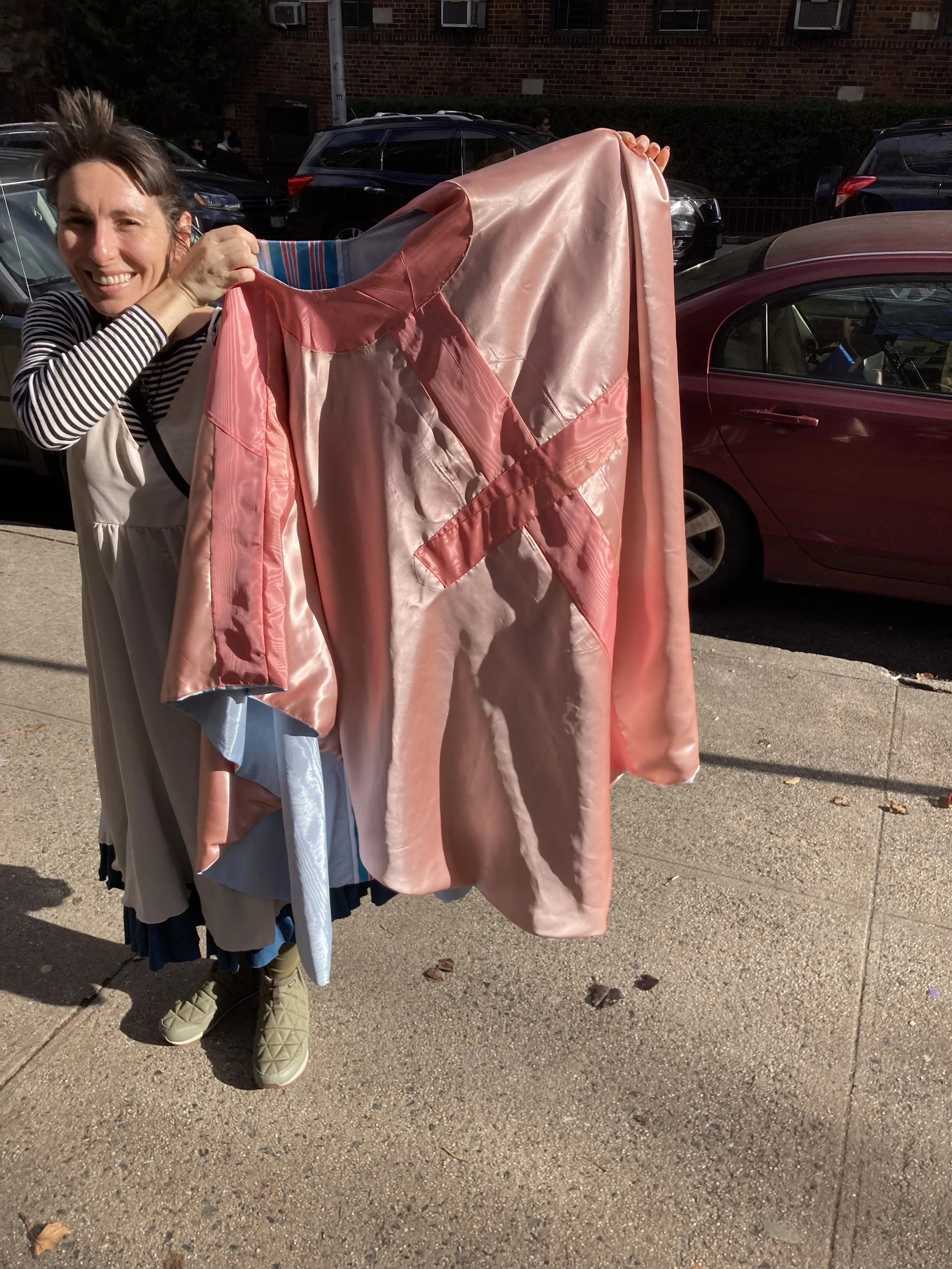
Kaylyn showing the back of the rose-colored side…
And especially as we prepare to welcome the Christ-child, Emmanuel, “God with us,” we are invited to piece all that together—thinking back to last week—with softness. Because our tradition points our hope in the right direction—towards healing, and liberation, towards salvation from all that keeps our hearts too small, and our breathing too shallow. And that salvation comes to us not in power and might, but in vulnerability and need. So we need to be soft to glimpse it, to welcome and care for it.
The patchwork that is tradition points our hope in the right direction; and it also reminds us, again and again, that the reality of God will always surprise us. And if we can follow that surprise, if we can roll with it, rather than insisting on our own ideas of what is “supposed to happen,” God will exceed even our wildest hopes.
The prophet Isaiah can show us something about wild hopes. He imagines this highway, this “Holy Way,” that will lead the people of Israel out of their exile in Babylon, back to their homeland. “And the ransomed of the Lord shall return, and come to Zion with singing; everlasting joy shall be upon their heads; they shall obtain joy and gladness, and sorrow and sighing shall flee away.”
I’ve never lived in exile, but it opens up my heart to imagine what Isaiah's promise might mean to Ukrainians kicked out of the Donbas region, and Sudanese refugees displaced by civil war, and Palestinians packed into occupied territories, dreaming of their grandparents’ olive groves. When they get back, if they can get back, what songs will they sing? Can we imagine the tear-stained, heartbroken joy will be upon their heads?
To return after a long exile to your home—of course the home is not there; it has been destroyed, bombed out. But Isaiah offers this further hope, as if in answer, that the land, the earth itself will be a source of healing and abundance. “For waters shall break forth in the wilderness, and streams in the desert; the burning sand shall become a pool, and the thirsty ground springs of water.”
Gaudete: Rejoice. The end of all our searching, the fruit of our faith will not be certainty, will not be status or self-righteousness or victory—but will be the taste of water from a well that has burst forth in the midst of the desert. And at the taste of that water we will rejoice.
As beautiful as Isaiah’s vision is, our tradition tells us to hold our expectations loosely. Our rejoicing will likely not come in the form we expect; it might not go down exactly the way we think. The Holy Way is a winding way, a journey into the unknown. And so we travel with humility.
The humility we see in John the Baptist and his disciples—who did not expect John to be the end all-be all, but who were waiting for one who was still to come.
The humility of Mother Mary: a teenage girl, preparing for her wedding, who is visited by an angel who tells her that she will conceive and bear a son, and he shall be called Emmanuel—God with us. I once saw a small modern sculpture of this Annunciation scene in the Vatican museum, and Mary is sprinting away from the angel, overwhelmed by this news. It’s way too much, to be the God-bearer; this was not part of her wedding plans.
And yet as the story goes, Mary gathers herself and goes to visit her cousin, Elizabeth. Mary’s first instinct, as she processes this overwhelming news, is to seek out community. And she finds just the community she needs: Mary did not know when she set out, but Elizabeth is also mysteriously and miraculously pregnant. Perfect company: together they wonder, together they worry, together they rejoice.
And in the story from Luke’s gospel, Elizabeth asks Mary how she is feeling about all this. And she sings this improvised song, the song we chanted together, “the Magnificat.”
My soul proclaims the greatness of the Lord,
my spirit rejoices in you, O God my Savior, *
for you have looked with favor on your lowly servant.
Let me close by returning to this point I made earlier about tradition as something we continually pull apart and piece together, preserving what has integrity and joining it to what we are learning and experiencing now, the best we can find, the best we can afford. And doing that with softness, humility and awe at what that tradition points to.
In Mary’s song itself, we see how tradition is living and renewed. Because her song isn’t a spontaneous creation, spun out of thin air. Mary is riffing on a much older song that Mary had inherited from an ancestor, a great-great-great-great-grandmother named Hannah, who also had a miraculous pregnancy. Hannah’s song is also a song praising this God of justice and joy, who exalts the meek and pulls the needy up out of the ash-heap, and casts down the proud and mighty.
Mary’s song carries forth so much of Hannah’s legacy, and yet Mary brings something of her own to it: the wonder that this is happening to me.
Tradition pointed her hopes in the direction of this God of justice and joy—but she could not have anticipated that she would find herself at the center of it, that this justice and joy would come, literally through her, be born from her body.
Could the hope of our ancestors be our own—could their dreams be realized, here and now, in us? Could the salvation you dream of for this wounded world be born…in you?
And when it is…what rejoicing…
Amen.