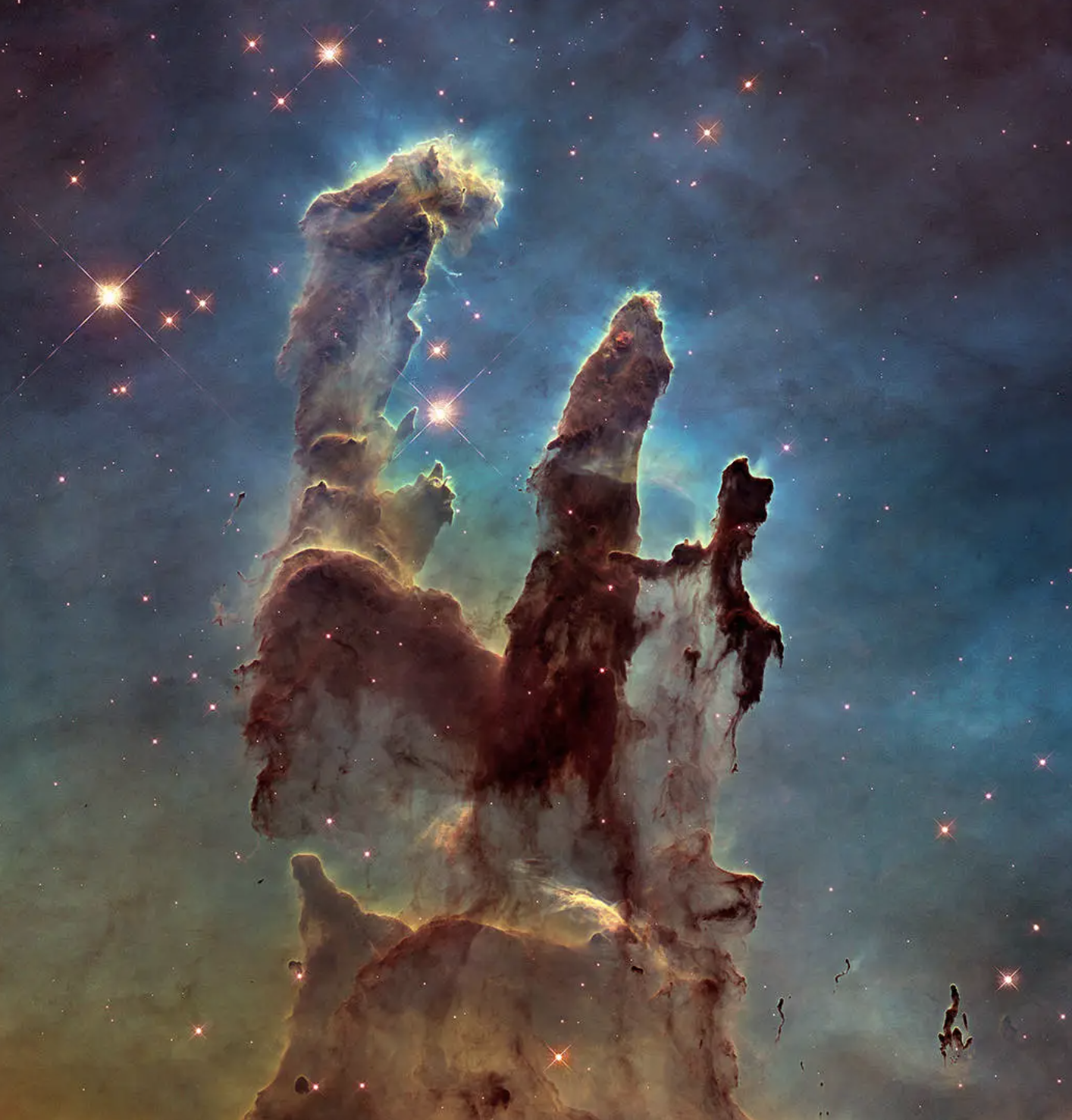
the Pillars of Creation
Wonderings:
I wonder if you’ve ever been caught off guard by something really beautiful or moving when you were not expecting it?
I wonder when you’ve felt small, overawed?
Reflection based on these wonderings + the readings assigned for the Last Sunday after the Epiphany.
Exodus 24:12-18, Psalm 2; Matthew 17:1-9
Let us speak, and listen: held in the presence of our loving, liberating, and life-giving God. Amen.
A few weeks ago, I spent a few hours on a Saturday at the Museum of Natural History. What do you think I went to see first? Dinosaurs. Spent about 20 hectic minutes zipping around among the dinosaur bones before my companion declared she was ready for lunch. So, wait wait wait for the elevator, then down to the lower level where the cafeteria is. Navigated the crowds and the lines, got a veggie burger and coffee for myself and a slice of pizza and an apple juice for my companion. The dining area is jammed; we find the one open table, sit down, and here I’m able to enjoy about 10 minutes of chitchat with my companion and some people watching. I’m even able to scan the headlines of the New York Times on my phone, before my blood pressure begins to rise, and I switch to the Museum of Natural History app, to see what exhibition we might see next, that might be developmentally appropriate for my companion, not be super crowded, and doesn’t require a separate ticket that we have not already paid for.
And I see there is an exhibition of super hi-resolution photographs of butterflies and other bugs, and I’m thinking, bingo. Let me take my companion to see the colorful bugs up close and reflect quietly with my companion about the colorful bugs. I would like to hear what she notices about their unique characteristics. So we wait wait wait for the elevator, which takes us to the second floor, and we quickly find the photography exhibition in this wide hallway space. But do we reflect quietly together about the colorful bugs? We do not. My companion, hopped up on apple juice, literally jogs around the exhibition, stops in front of one photograph and shouts “butterfly!”—then immediately runs out of the exhibition, down a ramp I had not yet even seen. I had thought there was only one exit to this exhibition, but I was wrong. I had also thought that this was an exhibition of very cool-looking insects, but actually I was wrong about that too—they’re all insects on the verge of extinction. So now I am alone, feeling unexpected climate grief, mixed with panic—because my companion has only gained speed as she ran down the ramp and is now rocketing away into a whole other wing of the museum—the Rose Center for Earth and Space. She’s gone to outer space.
Now I am shortly going to get to the point of this story. But first let me sum up my mental and emotional state in this moment: not very good. Before the climate grief and the wait wait wait for the elevator and the crowded cafeteria and the mad dash through the dinosaurs, it had actually been kind of an ordeal to get to the Museum at all. My companion did not want to put on her boots, or her coat. And then she had been “too tired” to walk to the subway, so I had let her ride on my shoulders, and then, when we got to the subway platform, she had briefly let go of my hand as the train was pulling in, which about gave me a heart attack. And before that, it had been a hard week. So again, my mental and emotional state was not very good.
But my companion has slowed down a little as we walk around the Hayden Planetarium, and I have enough time to text someone to see if the snow is sticking to the sidewalk here at the church, and if so, to spread some salt. I also had enough time to note that there is an exhibit that runs along the railing on this walkway, that is moving from the smallest known objects in the universe—electrons and quarks—on through orders of magnitude to the largest objects in the universe: whole galaxies.
And I’m sort of skimming this information as I pass, until I come to an image that I recognize. An image that moved me deeply back in 2022, when NASA released the first images taken by the James Webb Space Telescope. This image—of a nebula known as “the Pillars of Creation.” And I was moved again, by the beauty of this image, by the awareness that these pillars are just a small part of the Eagle Nebula, by the awareness that a nebula is a place where stars are born. But there in the museum there was something on this image I had never seen before. A measure of scale.
The image shows that from here to here, that’s one light-year. 5 trillion, 878 billion, 625 million, 370 thousand miles.
And I got choked up. I get choked up now, telling you about it. I felt this overwhelming sense of awe: I was reminded of my own smallness, the infinitesimal blip of my life on the timescale of the universe. I felt a wild urge to kneel down right there, before the vastness of creation, to say “holy, holy, holy.”
And I felt my whole body loosen and let down. It was like someone had pressed the reset button on my nervous system. And for a moment I felt unsettled, unsteady on my feet, suddenly aware that I was standing on a swiftly tilting planet in the midst of deep space, in an insignificant solar system in a minor galaxy. I was a weak and tiny creature, touching the pillars of creation. Touching the sacred, the forge of distant stars.
2 or 3 millennia ago, there were no telescopes. There was no understanding of our actual position in the cosmos. But people did not need to see into deep space to touch the sacred. They could see the night sky for themselves. And they could go up to a high place, to the top of a mountain, to stand at the very threshold of the heavens.
When Moses climbs to the top of Mount Sinai, it is understood that he is climbing to the dwelling-place of God. And the presence of God is overwhelming: “the glory of the Lord was like a devouring fire on the top of the mountain.” And we might think of that awesome encounter there as pressing the reset button on the nervous system of these traumatized and exhausted people, who have just escaped from slavery in Egypt. They are awestruck. Awestruck that God sees them—sees them in their infinitesimal smallness—and nonetheless cares for their healing and liberation. And this awesome God who appears in a pillar of cloud and fire shows them how to live from there on out. God offers laws and commandments to guide them into right relationship with this awesome God, and with one another.
The Gospel of Matthew also tells a story of an awe-inspiring encounter on a mountaintop. Here it is Jesus who goes up, with his disciples Peter, James, and John, and there Jesus is transfigured into glory. And I love this little detail about Peter, who is trying real hard to take this all in stride, saying “you know Jesus, it is good for us to be here; if you wish, I will make three dwellings here, one for you, one for Moses, and one for Elijah. We could sell tickets, it would be the hottest attraction between here and Damascus.”
And as if to underscore the point, this voice booms out from the heavens, “This is my Son, the Beloved; with him I am well pleased; listen to him!” In other words, shut your trap, Peter, and hit that reset button! And the disciples fall to the ground, overcome by fear.
Matthew is clearly patterning his story after Moses’ encounter on Sinai, but notice the difference. Here, after the disciples are put in their place, they are not left with stone tablets of laws and commandments. They look up and it’s just Jesus, in his normal clothes, telling them not to be afraid. As if Matthew is saying that the authoritative source for our own lives is ultimately not to be found in a legal code, a closed list of do’s and don’ts, but in the example of this person, the one God calls Beloved.
Matthew also clearly patterns his telling on the classic formula by which God’s chosen is anointed. We heard this in our psalm: “You are my son, the Beloved, this day have I begotten you.” But notice the difference. In our psalm, we hear that this ruler will make the ends of the earth God’s possession, shall “break them with a rod of iron, and dash them into pieces like a potter’s vessel.” In the psalm, the anointed one inspires fear, demands submission.
But in Matthew, the anointed Jesus says “do not be afraid.” And he goes with his disciples back down the mountain, back into the stress and overwhelm of everyday life. He goes with them, knowing that the way they are living together, in the pursuit of justice, will lead to his death. He goes with them, knowing that his commitment to the kin-dom of God means that his body will be broken on the Cross.
***
Invitation into saying the Nicene Creed…
On this last Sunday of Epiphany, on the threshold of Lent… one last invitation as we engage this practice of saying the Nicene Creed together.
I often find the Creed boring; like many things I have memorized, I often don’t really pay attention to what I’m saying. But note that the scope of this is cosmic. We trust in the God who created all that is—and is still giving birth to stars out in the Eagle Nebula. We trust in the God who cares about this bit of rock we call Earth, unlikely home to intelligent, carbon-based life, and becomes a human being who walks among us. Who suffers with us, and dies for us, and whose life cannot be contained by death because this is the life that gives birth to stars. And we trust that this God is still with us, sharing that life with us, freely, uniting us to one another and to those who have died: ash to ash, stardust to stardust.
So the invitation today is to say these words in awe: as though standing before the pillar of fire, before the Pillars of Creation.